Monday, November 24, 2008

Stop and think for a minute


It is with growing discomfort that I'm hearing Bank of Ireland and Irish Life and Permanent have been approached by private equity firms interested in paying €5bn.


I would urge the Irish Government not to allow this to happen.


It would be Eircom all over again.


Private investors will sweat the assets while the country gets a bum deal.


Irish businesses and citizens need the injection of funds for sure, but at what price?


Tuesday, November 4, 2008

Feelin' good


After my first wave of emotion on hearing of Barack Obama's victory, only the immortal Nina Simone's word's can sum it up:


Its a new dawn


Its a new day


Its a new life


And I'm feeling good


Now let's begin to make the world a better place.

Saturday, October 18, 2008

The Government of Ireland

I take pride in the fact that I’ve never had any political allegiances. It goes back to a time when I was probably six or seven and a General Election was underway. You had to be one of two things: pro-Fianna Fail or pro-Fine Gael. Anyone who knows anything about politics in this fair country knows that your political convictions are inherited rather than inspired and much of this goes back to the Civil War.

One of the neighbours’ kids was rabidly praising one of these parties and threatening to punch anyone who disagreed. It was the closest thing to realising what the Hitler Youth may have behaved like in the 1930s. I was disgusted.

I actually have no faith in Irish politicians, at least some of the ones I have seen in action. Half of them can barely speak coherently, need a good tailor and should steer clear of golf clubs and tents full of builders.

As I grew older I was proud to exercise my democratic right to vote and based by decisions on who I thought would be the right people to do the job, reasoning their policies rather than a bloodline of allegiance.

I think this week I was proven right. People should only vote on who they consider will be good at the job. The next time a General Election is called this method of reasoning and judgement will be applied and hopefully incompetent politicians will be replaced by people with insight, judgement and reason.

On its first perusal Budget 2009 seemed prudent and a ‘not so bad’ mood swept the office where I worked. The next morning though anger, outrage and disgust had filtered through. Some people gave out about things like a tax on parking spaces, but the real hurt – genuine hurt – was felt by fair-minded people over the betrayal inflicted on our country’s senior citizens by introducing means-testing for medical cards.

I can’t agree that wealthy people like retired judges or politicians should be entitled to an automatic medical card but having witnessed on many occasions the incompetence of our civil servants, schemes like means-testing confuse, exasperate and delay. No good will come of this.

Elderly people who have worked all their life, paid their taxes and find the medical dimension of their lives an ever increasing reality have enough to worry about. The incompetence of the HSE is well documented. The cost of visiting a doctor is already prohibitively expensive and I thank God for my good health that I don’t have to visit an Irish hospital any time soon.

In one fell-swoop the current Government of Ireland has abandoned its senior citizens.

Also, it has not only cut funding of computers in Irish schools but has increased pupil-to-teacher ratios. This latter move reinforces in my mind the fact that the Irish Government has never appreciated nor understood the gift of the ICT industry on their shores, a sector that will be watching this decision with interest. It employs 85,000 people and wants to do more. Pay attention teachers, parents and politicians, there are good well-paying jobs for people with talent. Hopefully, there always will be.

In today’s Irish Independent James Downey wrote with insight on Middle Ireland’s reaction to the Budget: “It expected hardship. It got it. What it did not get was coherence.”

I could qualify this: it expected hardship. It did not expect to be heart-broken.

The Government may or not do a U-turn on the medical card issue. But whatever it does do not forget what happened. The next time a General Election is called base your voting decisions on reasoning the right people for the job. Don’t be blinded by blood allegiances. Do not forget this fiasco.

JK

Tuesday, September 30, 2008

Bankers!


All my life I'd been led to believe that banks and those that worked in them were better than the rest of us. They were always correct and an admonishment for being overdrawn or not paying your credit card bill on time was like a metal ruler across your knuckles or moral disproval from a priest or rabii.


The events of the last few days have no doubt focused my mind and the minds of others that banks are not infallible and that those who run them can mess up like anyone else. But when you read the business pages and hear of city boys and girls in London being paid bonuses of six-figure sums, or chief executives of Irish banks being also paid such sums, it reinforces the notion that these people must have been on speaking terms with God.


No doubt in recent days these useless bankers must have been wishing they had a cellestial telephone line directly to God.


I remember having the temerity to ask for a student loan when I was 19 only to have to listen to the bank manager tell me "no" in 15 different ways for half an hour. I felt he got some kind of pleasure out of the experience.


While I completely understand US citizens' anger at how these overpaid crettins with their golden handshakes and skyscraper bonuses do not deserve to be bailed out, this morning's move by the Irish Government - though not without potential pitfalls - to guarantee Irish-owned banks was the right decision.


Firstly, it instils confidence, the rest of Europe may follow.


Ireland isn't of the same scale as the US or UK to have such financial meltdowns, but our objective to remain an international trading centre should stay on track.


The recent days may actually put us back on the road we should have stayed on. Wages may become more real and continue to attract investment, our corporate tax rate is still an important selling point and if the Government actually does stick through to the National Development Plan's infrastructural investments we may ride this crisis out and be in a position of relative strenght.


We lost our heads during the Celtic Tiger years, we became fat and bumptious with our SUVs, golf clubs in the sun and having to have a house bigger than our neighbour's.


That isn't Irish, that isn't what makes us special. What makes us special is having a clear head in a crisis, working our asses off and being honourable and charitable to those in need.


I read somewhere that the Irish used to rush to the sound of gunfire like salmon to the stream. In some ways we are a fatalistic people, but ultimately an optimisic one. We'll not only need clarity, optimism and realism in equal measure in the months ahead, but wisdom and fortitude.

Wednesday, September 24, 2008

JK on how to make an entrance


After being harangued by friends of mine who are throwing a party to reply with darn RSVP so whatever system they are using gives them accurate numbers I sighed wearily in the office that I never, really, RSVP anyone.


Never RSVP


So when you do show up you create a cloud of confusion/consternation/relief/delight/anger

Or you get shown the door for the scamp that you are

Sunday, July 20, 2008

The iPhone 3G: A thing of dazzling lights and shimmering beauty


At a party once I had a conversation with fellow technology journalist Karlin Lillington about the role of technology journalists, bloggers and the world at large. We both agreed that we have been privileged to witness first hand the greatest cultural revolution since the invention of the printing press. Perhaps Karlin more than I since she grew up in and around Silicon Valley.

But the last 15 years of my life have been spectacular and breath-taking. I’ve met fantastic and interesting people in the industry – including Craig Barrett and Vint Cerf – and attended at least three addresses by Microsoft’s Bill Gates and one by Google’s Sergey Brin and Larry Page. I’ve been to all ends of the world, from Singapore to Seattle, and even got mild frost bite on a mountain near Salt Lake City. Standing on the Grand Canal in Venice on a hot day sipping chilled white wine or boogying to James Brown in Dublin have more than compensated.

When I began in journalism it was very hard to get a start in any form of paid work in the craft. In 1994 after stints of court reporting for the Irish Independent, I eventually got my break – a chance to edit and develop an electronics magazine called Advanced Manufacturing Technology (AMT) and a sister publication called Irish Chemical Journal before graduating to Irish Computer and then becoming tech editor for Business & Finance and witnessing – and partaking in – the excesses of the dot.com era. The onset of www.siliconrepublic.com and chronicling the tech landscape for the general public through E-Thursday and Digital Ireland have only added to and steadied my perspective on the technology or, should I say, digital revolution.

In the early 1990s, because I had no academic background in technology I made it my mission to go and visit electronics plants the length and breadth of Ireland that were the pre-cursor to the Celtic Tiger boom, ranging from Nortel in Galway to Seagate in Clonmel, Motorola in Swords, ALPS in Cork and Apple Computer, which conducted a major amount of manufacturing in Cork city.

On that visit in 1995 I met current country sales manager Liam Donohoe and got to witness the relentless rhythm of chips being hammered and glued onto printed circuit boards in the manufacture of notebook computers destined for the four corners of Earth. I began to see every single one of these plants as integral to a vast supply chain in which Ireland was playing a small but worthy role. At the time, if I said “technology journalist” to anyone they would have looked at me as if I had two heads. The vast potential of technology in shaping the world and entertaining and informing our lives was beyond me at that point, as it was most people in a country where PC penetration was lacklustre.

The point I want to make in this post is I believe technology and its coverage has come full circle to a point where its overall potential is being only now being realised by devices like the Xbox 360 and yes, of course (I’m getting to it) the Apple 3G iPhone. The vast implications again are beyond us and we are on the brink once more of an exciting new time.

When I received my first text message on a rainy November evening in Dublin from veteran tech writer Ray Okonski, letting me know his copy for a magazine I edited called Communications Today was filed, it was an epiphany.

On a Sunday afternoon as the iPhone 3G buzzes in my hand to let me know a new email has arrived, interrupting my leisurely look at Top Ten alternative rock albums on iTunesColdplay’s Viva la Vida is number one – I realise once more the potent forces about to be unleashed.

The iPhone 3G is an elegant piece of technology that should send tremors of terror through established players like Motorola and Nokia, and that linear menus and half-way houses of touch screens and buttons are on the out. Nokia’s N95 is a brave and beautiful effort, while Samsung’s Tocco – what I consider a mini-iPhone including As Gaeilge – is the only thing that currently comes close.

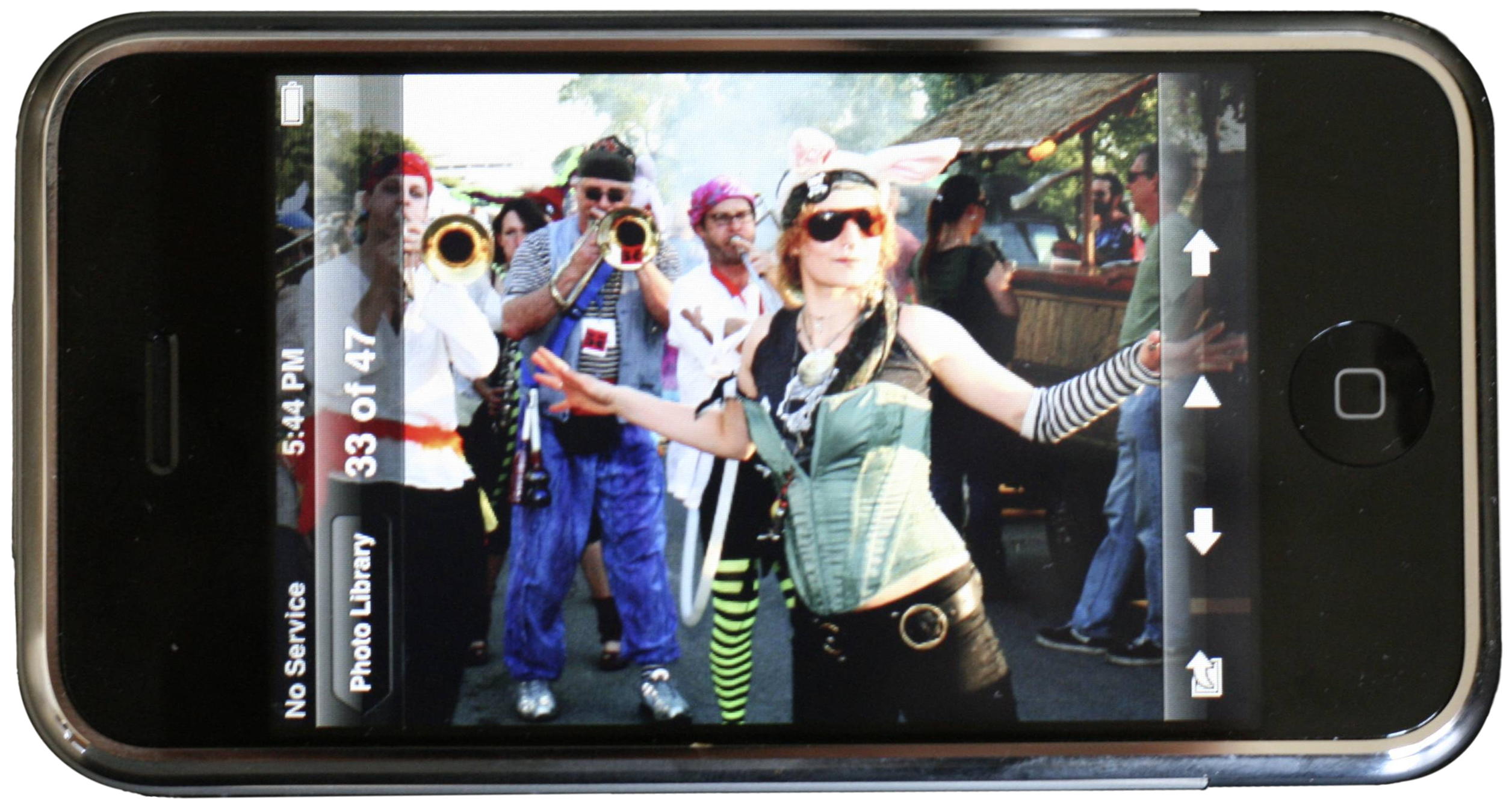
The things that have amazed me the most about the iPhone 3G – an 8GB version – are the simple to use Safari web browser (turn it on its side and you get full screen internet), the iPod functionality and the wonderful picture album. To get a close up of the image on your screen you simple spread your fingers to expand and to contract just pinch your fingers.

Sifting through photographs is again, quick and easy. Just flick with a finger and a carousel of your favourite shots just flick by.

The mapping function is surprisingly quick, calculating the fastest route to get from A to B, and the writing function for texts, web addresses and notes is a massive step forward. I have to admit the 3G coverage – poor where I live – has underwhelmed me, but thanks to a Wi-Fi network in my house I can appreciate the device’s full potential.

But ultimately it’s the elegance of the operating system that wins it for me. Nothing the established mobile industry has put together thus far comes near in terms of simplicity and ease of use. You’d think they’d learn. Well, they will. Just like the Japanese at Pearl Harbour did for the Americans, Apple has awakened a sleeping giant … an alarmingly complacent mobile industry … from its slumber.

Apple deserves the success it will derive from the iPhone. It did its homework and painstakingly realised its vision. And of course thanks to Steve Jobs’ hype machine and savvy marketing organisation.

It also deserves the kudos for bringing the mobile revolution back from an unannounced four year holiday. Expect a new revolution in entertainment, business and our working lives to come our way as the technology industry is once again imbued with purpose.

It is just one element of a vast movement underway, such as two-way digital television that electronics giants such as Intel are working on, according to the company’s home entertainment VP Eric Kim, and that should debut at the next Consumer Electronics Show.

The world’s too vast for us now …. Seeya!

Tuesday, June 24, 2008

Will the last person to leave the country please turn out the lights

So it's official - we're in a recession. http://www.independent.ie/national-news/we-blew-the-boom-1419958.html

I sat stony-faced in my car as the findings of the ESRI were read out on the radio. I partied hard with everybody else but never forgot the dismal 80s and 90s - when as a college student having to sign on the dole because there weren't even part-time summer jobs available.

This shocks me to my core but I have to admit along with everybody else that we had to have seen this coming. We had our economic boom, our Celtic Tiger. Why don't we just make the right decisions to ensure at least - good times or bad - our dear nation knows stability. Stability is a form of prosperity.

The rumour mills suggest that the government is planning to announce ubiquitious broadband as part of its National Broadband Strategy next week (3 July).

I couldn't urge this more. A person at home with a computer and a broadband connection is capable of setting up a business or an industry - as we have seen in recent years. It's a lot more than their counterpart at home in the 1990s had. Except for a one-way plane ticket to America.

This is not an epiphany, it's real. Enterprise and entrepreneurship are the antidote for unemployment and recession. Encourage people to use computers and broadband to beat the recession, they can work for anyone from anywhere. They can create businesses based on anything from selling stuff on eBay to using their intelligence to write, provide consultancy services or develop technology. This is the way out. Failure to provide them with the tools is economic sabotage. Let's hope intelligence prevails.